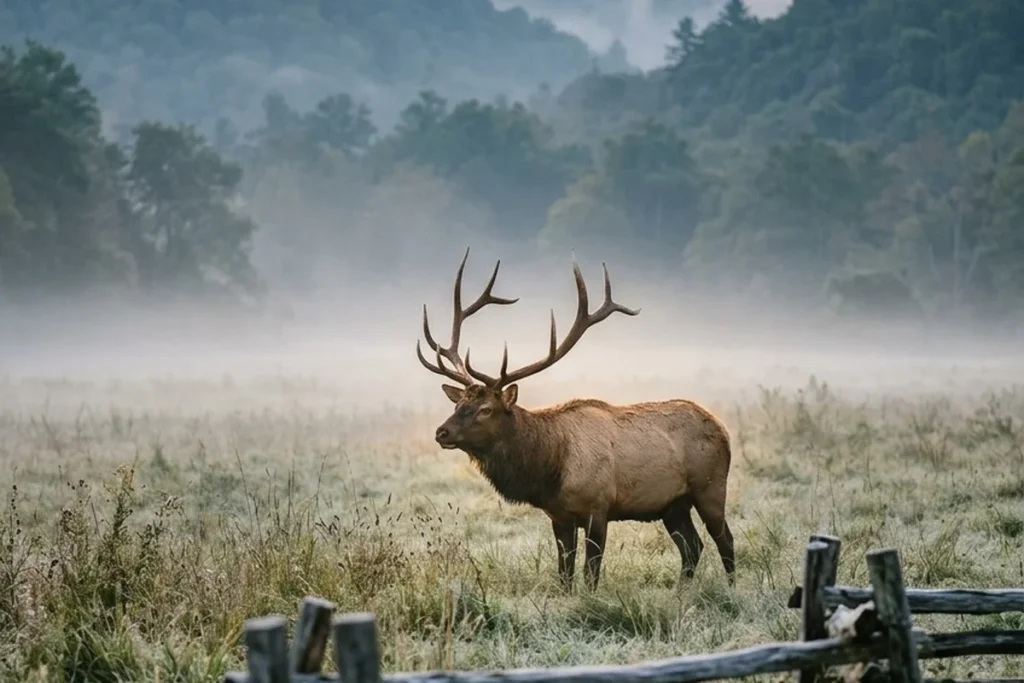
Where to see elk in the Smoky Mountains 🦌
Where to see elk in the Smoky Mountains comes down to two valleys, and from the Tennessee side only one of them makes sense on a weeknight. That is the whole answer, and almost nobody says it out loud. Search the question and you will get a hundred photos of bulls standing in gold morning light in Cataloochee Valley, with no mention that Cataloochee is a two-and-a-half-hour commitment from Sevierville, the last eleven miles of it on gravel with no guardrails.
The other valley is Oconaluftee, on the North Carolina side of Newfound Gap Road, and it has elk grazing in an open field beside a paved parking lot with restrooms. It is not as wild. It is also the trip you can actually pull off with kids in the back seat before breakfast.
Here is the honest version of both, plus the timing that determines whether you see fifteen animals or none. Elk are not on a schedule you can bully. They are on a light schedule and a temperature schedule, and if you show up at eleven in the morning on a bluebird day you will drive home having seen a field.
One more thing worth knowing before you go: these animals are not a fixture of the landscape the way black bears are. Elk were hunted out of the southern Appalachians by the mid-1800s, and the last eastern elk in North Carolina disappeared in the 1790s. The National Park Service put twenty-five of them back into Cataloochee in 2001 as an experiment. It worked. What you are looking at is a twenty-five-year-old comeback, which is a very different feeling from just spotting wildlife.
The two valleys, and what each drive actually costs you
Oconaluftee (Cherokee, NC) is the practical one. The fields around the Oconaluftee Visitor Center and the adjacent Mountain Farm Museum are the most reliable roadside elk viewing in the park, and both are free to walk. You get there on Newfound Gap Road (US 441), the only road that crosses the park end to end. It runs 33 miles from Sugarlands Visitor Center outside Gatlinburg to Oconaluftee, and it takes about an hour if you do not stop, which you will.
From a cabin on the Sevierville side, budget roughly 90 minutes door to field once you add the run down through Gatlinburg. If you leave at 5:30 a.m. in late September you are standing at the fence line for first light with time to spare.
Cataloochee is the wilder one, and the harder one. It holds one of the park’s two main herds and it is genuinely beautiful, an old settlement valley ringed by mountains with historic churches and farmhouses still standing. The catch is access. The most direct route is I-40 east to North Carolina exit 20, then 0.2 miles on Route 276, then a right onto Cove Creek Road and eleven miles of signs into the valley. About fifteen of those minutes are on gravel. The National Park Service describes the entrance road plainly: winding, narrow, steep drop-offs, no guardrails, and you may have to stop or back up to let an oncoming vehicle pass. Horse trailers use it too.
From Sevierville that is a two-and-a-half-hour drive each way in good conditions. Doable, but it is a whole day, not a morning.
There is a third option locals mention and visitors rarely try: Balsam Mountain, up above Cherokee off the Blue Ridge Parkway. Elk turn up there and along the Parkway itself, and the elevation keeps it cool. It is the least crowded of the three and the least predictable.
Practical notes for all three:
- You need a parking tag if you park longer than 15 minutes. Park it Forward tags run $5 daily, $15 weekly, $40 annual. Driving through without stopping does not require one, but you are not going to watch elk from a moving car.
- Cell service in Cataloochee is effectively zero. Download the map offline before you leave the interstate. There is no live rerouting once you are on Cove Creek Road.
- Newfound Gap Road tops out at 5,046 feet and closes for weather. In shoulder season, check the park’s road status page the night before and again in the morning.
- A standard rental sedan handles Cove Creek Road in dry weather. Slowly. It is not a four-wheel-drive road, it is a patience road.
The part everyone gets wrong 🍂
The fields are closed during the rut. This is the single biggest misunderstanding, and it wrecks a lot of trips. From September through October, when the breeding season is on, the fields at both Oconaluftee and Cataloochee are closed to all visitors. You view from the roadside and from designated pull-offs. Those dreamy shots of a photographer standing in the grass twenty yards from a bull were either taken outside the closure or taken with a lens that costs more than the trip. Plan to watch from the fence line, and bring binoculars, because that is the difference between a good morning and a frustrating one.
Fifty yards is the law, not a suggestion. Willfully approaching an elk within 50 yards, or at any distance that changes the animal’s behavior, is illegal in the park and carries fines or arrest. During the rut, bulls have elevated testosterone and will charge anything they read as a challenge, including vehicles. Cows are protective of calves. If an elk walks toward you, back away calmly and give it room. Use your car as a blind if you can. Elk are used to cars and wary of people on foot, so you will get closer, longer looks from the driver’s seat than you will standing beside it.
You will hear the rut before you see it. Bugling is the point of a September trip. It carries a long way across a valley in still morning air. Roll the windows down, cut the engine, and stop talking for a minute. Most people miss this because they are narrating.
Midday is a bust. Elk feed in cool air, so they come out at first light and in the last ninety minutes before dark, and they bed down in shade in between. The one exception worth planning around: overcast days and the hours right before and after a storm, when they will graze much later into the morning. A gray, drizzly September morning is not a ruined trip. It is the best trip.
Do not stop in the lane. Elk jams work exactly like bear jams. Pull completely off the road, all four tires clear of the pavement, or keep moving to the next pull-off and walk back.
Late August is when the antlers peak. Bulls have fully grown racks by the end of August, and a mature set can span five feet and weigh close to fifty pounds. Antler tissue grows up to an inch a day, which makes it the fastest-growing tissue of any animal on the planet. That is the fact that gets the kids interested.
From our porch 🌄
We are Eddie and Ariana. We came up from Miami, kept the dog, and learned most of this the way everyone does, which is by getting it wrong first. Our first elk attempt was Cataloochee, in the dark, on four hours of sleep, because that is what the internet told us to do. We hit the gravel at 5:45 a.m., crawled the eleven miles in, and arrived to fog so thick we could not see the far side of the field. We drove two and a half hours home having heard one bugle and seen nothing.
Now we do it differently. If we have a full free day and the forecast is clear, Cataloochee is worth the whole production, and we make a day of it with the historic buildings and a picnic. If we have a morning, we go to Oconaluftee, and we tell guests to do the same. Ninety minutes each way, coffee in the car, back before the crowds hit downtown Gatlinburg. It is not a lesser trip. It is the trip that actually happens.
The other thing we tell people who book Sunny Sierra Cabin directly: check the sky, not the calendar. We have sent guests out on gray, unpromising mornings that turned into the best wildlife hour of their week, and watched perfect blue-sky days produce empty fields by eight a.m.
Quick answers
- When is the elk rut? Mid-September through late October, with the loudest stretch usually late September into early October.
- Best time of day? First light, or the last ninety minutes before dark. Overcast days extend the window.
- Can I see elk outside the rut? Yes. Elk graze the Oconaluftee fields year-round, morning and evening. You just will not hear bugling, and the bulls will not be sparring.
- How far is it from Sevierville or Pigeon Forge? Roughly 90 minutes each way to Oconaluftee, roughly 2.5 hours each way to Cataloochee. Check Google Maps with a “depart at” time set, since summer and leaf-season traffic through Gatlinburg changes the answer a lot.
- Do I need the parking tag? Yes, if you park more than 15 minutes. $5 a day, $15 a week, $40 a year.
- Do I need binoculars? Effectively, yes. The field closures during the rut mean everything happens at distance. A cheap pair beats no pair.
- Are elk dangerous? During the rut, treat them like you would a bull in a pasture. Bulls charge, cows defend calves, and 50 yards is a federal minimum.
- Where are the calves? Born mid-May through mid-July and hidden in tall grass. If you see one alone, the mother is nearby. Leave it.
Elk viewing is one of the few things in the Smokies that rewards leaving early more than it rewards spending money. Set an alarm, bring a thermos, and pick the valley that matches the time you actually have. The gray mornings are the good ones.
Sources
- Elk rutting season underway in Great Smoky Mountains National Park — National Park Service
- Cataloochee & Balsam Mountain Area — National Park Service
- Elk viewing in Cherokee — Visit Cherokee NC
- Newfound Gap Road: 31 Miles of Incredible Mountain Landscapes — Smokymountains.com
- Park it Forward parking tags — Pigeon Forge
- Elk Watching 101: How to see elk in Cataloochee Valley — Visit Haywood